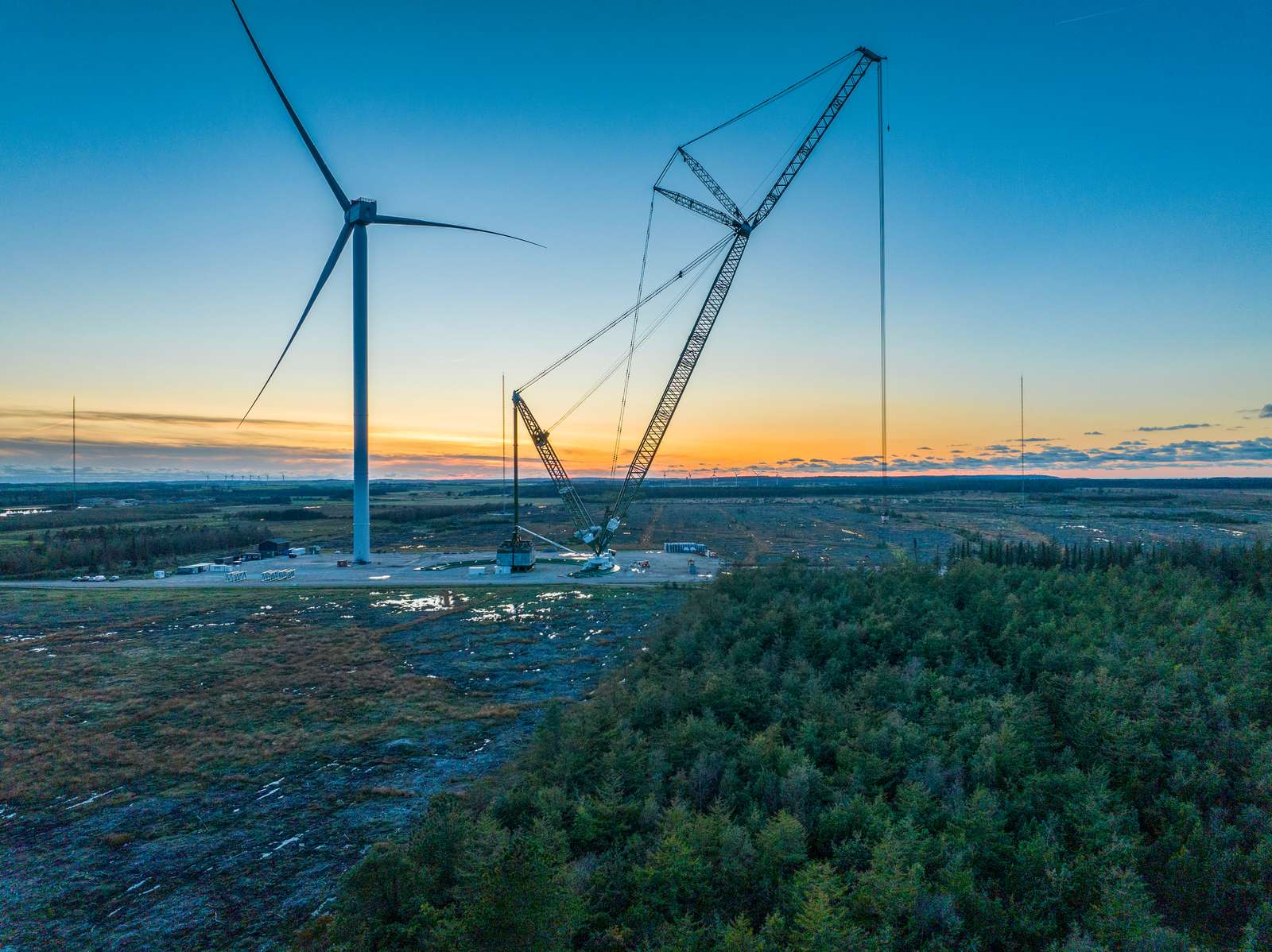
For more than a decade, Test Centre Østerild in Thy has enabled the wind energy industry to test some of the world’s largest and most advanced wind turbines. In this way, the centre plays an important role in developing and validating the technologies needed for the continued expansion of wind energy in Denmark and internationally. At the same time, around 50,000 people visit the test centre each year to see the large turbines up close.
However, the activities taking place at the centre also extend into the surrounding economy. The construction of foundations, installation and replacement of wind turbines, maintenance of technical equipment, and the presence of employees and suppliers all create demand for goods and services from local and non-local businesses.
A new analysis prepared by DTU Wind and Energy Systems examines how much of this activity supports the economy of Thisted, Morsø and Jammerbugt municipalities.
The analysis finds that activities at Test Centre Østerild generated total demand for goods and services of approximately DKK 1.5 billion between 2020 and 2024. Around one third of this demand, approximately DKK 500 million, is estimated to have been supplied by businesses in the three municipalities over the five-year period.
Effects throughout the local economy
The analysis considers more than the businesses supplying goods and services directly to projects at the test centre. It also includes activity among their suppliers and the additional demand created when income generated through this activity is spent in the local economy.
In the analysis’s baseline scenario, the combined effects correspond to annual local production of approximately DKK 140 million and gross value added of DKK 58.3 million. The estimated employment effect is equivalent to 65.9 full-time jobs per year.
This does not mean that 65.9 new, permanent positions have necessarily been created at the test centre. Rather, the figure represents the amount of labour that the model estimates is required to meet the additional demand generated by the centre’s activities in the local area.
Most of the demand relates to investments in foundations, turbine installation, and the replacement of wind turbines and other major components. Between 2020 and 2024, such investments averaged DKK 284 million per year. Operation and maintenance contributed a further approximately DKK 16 million annually.
Consequently, the largest modelled effects are found in construction-related activities and the production of goods such as concrete products. However, the activity also supports other parts of the local economy, including accommodation, catering and a range of service industries.
Responding to a local request for greater insight
The analysis was prepared in response to requests from politicians and residents in the area for a more tangible assessment of the test centre’s local economic significance.
Its purpose is to quantify the economic activity associated with projects at Test Centre Østerild and to estimate how much of the resulting demand is supplied locally. The results provide an evidence-based contribution to the dialogue about the centre’s significance for the surrounding area, while also setting out the uncertainty associated with this type of economic modelling.
The calculations are based on several assumptions, including assumptions concerning the proportion of goods and services supplied locally and the replacement of major wind turbine components. The analysis therefore presents several scenarios. In the alternative scenarios, annual local gross value added ranges from DKK 31.6 million to DKK 103.1 million, while the employment effect ranges from 35.8 to 115.5 full-time jobs.
A model of economic activity
The results were calculated using a regional input-output model. The model traces demand through the economy and estimates direct effects, indirect effects among suppliers, and induced effects resulting from income and consumption.
Like all economic models, it represents a simplified version of reality. For example, it does not account for shortages of particular skills, commuting patterns, changes in wages or prices, limited production capacity, or the potential displacement of activity in other industries.
The findings should therefore be understood as estimates of the local economic activity supported by demand from Test Centre Østerild. They are not a count of new jobs or a measure of how many people living in the area have been employed as a direct result of the centre’s activities.
Read the full analysis
About the analysis
- The analysis covers activities at Test Centre Østerild from 2020 to 2024.
- The local area is defined as Thisted, Morsø and Jammerbugt municipalities.
- Total demand for goods and services is estimated at approximately DKK 1.5 billion.
- Approximately DKK 500 million is estimated to have been supplied by businesses in the three municipalities.
- The baseline scenario estimates annual local gross value added of DKK 58.3 million and an employment effect equivalent to 65.9 full-time jobs.
- The analysis was prepared by Raúl Labarthe Saric, DTU Wind and Energy Systems.