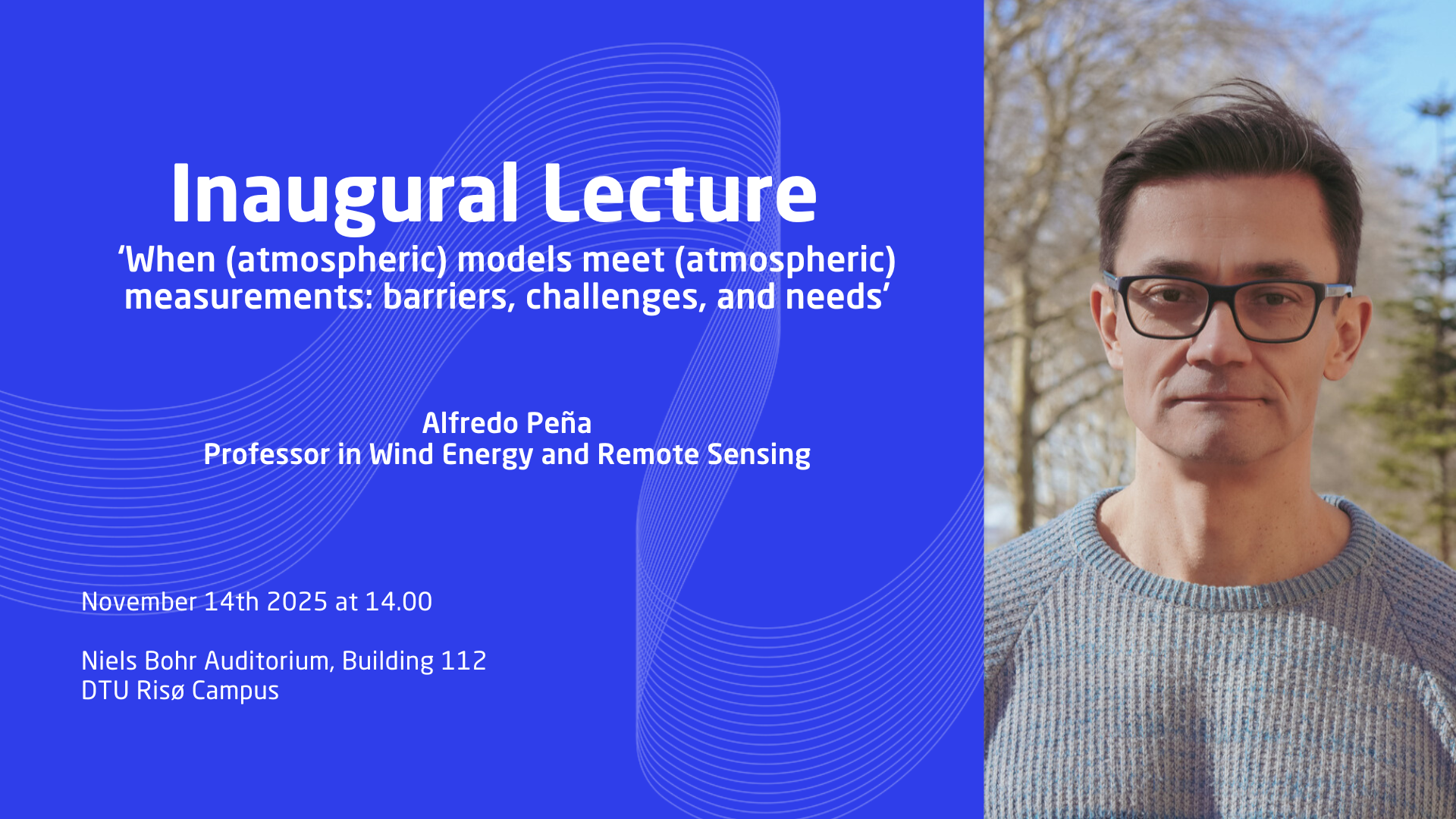
For Alfredo Peña, the professorship presents an opportunity to have a strong impact on the future of wind energy research. He is excited about leading research within what he considers “perhaps the strongest department of wind energy worldwide”. He looks forward to aiding the education of engineers and scientists and advancing the subjects which he is most passionate about: determining meteorological and wind conditions more accurately.
Moreover, the new role is a significant personal milestone. "Most importantly, at a personal level, it means that my colleagues, managers, and students recognize my contributions and dedication to wind energy science, research, and education for already more than 20 years," he shares. The professorship also brings increased responsibility. Alfredo Peña acknowledges the excellent examples set by his colleagues, who have demonstrated how to lead research groups and projects for the benefit of the department and the wind energy community. "I do hope that I have learned at least a little bit from them," he adds.
Alfredo Peña's appointment also holds significant implications for the Department of Wind and Energy Systems as the department thus prioritizes the discipline of determining meteorological and wind conditions accurately. These aspects are considered crucial for making wind energy more attractive and competitive. To achieve this, the researchers of the department combine the most advanced atmospheric modeling tools with cutting-edge atmospheric measuring tools.
Atmospheric Simulation and Remote Sensing Research
Alfredo Peña's research focuses on advancing the atmospheric modeling tools and the atmospheric measuring tools. His team of researchers concentrates on simulating the atmosphere at multiple scales, from engineering-like flow modeling tools to sophisticated numerical weather prediction models. These models can perform mesoscale and microscale modeling to simulate flow over complex terrain, over the sea, within and around wind farms, and turbulence. Additionally, Professor Peña is passionate about remote sensing, particularly lidar technology. His research exploits lidar to understand flow characteristics at various scales, from small meter scales to turbine and wind farm scales. He and his team also investigate how to best derive turbulence measures from lidars and other remote sensing instruments.
Projects on Lidar-Based Turbulence Measurement and Multiscale Atmospheric Modeling
Currently, Alfredo Peña is working on two parallel tracks. The first involves developing methods to determine turbulence measures with lidars using lidar and atmospheric physics as well as physics-based machine learning. The latter approach combines numerical datasets derived from physics-based models with, for example, neural networks. The second project aims to improve multiscale atmospheric modeling systems, particularly the methods used to model turbines in high detail, simulate the impact of sea waves on the atmosphere and turbine response, and reproduce turbulence at specific sites.
Looking ahead, Alfredo Peña is eagerly awaiting results from a proposal submitted before summer, in which he investigates the inhomogeneous character of atmospheric turbulence using lidars on drones.
In terms of education, the new professor is organizing the traditional PhD summer course in Remote Sensing for Wind Energy in Denmark. Additionally, this year, he is organizing a similar school in Japan in cooperation with several Japanese universities, hosted by Kobe University in September.
Alfredo Peña is going to deliver his inaugural lecture “When (atmospheric) models meet (atmospheric) measurements: barriers, challenges, and needs” on 14 November 2025 at 14-16 at DTU Risø campus, Niels Bohr auditorium.