Disciplines
- Composite structures
- Finite element modelling
- Non-destructive testing
- Structural health monitoring
- Computer vision and multimodal machine learning
Our research focuses on the development of advanced technologies to detect, monitor, and assess damage in wind turbine structures across manufacturing, testing and operation. The approach is grounded in AI, computer vision, and high-fidelity damage modelling using advanced finite element simulations, enabling detailed and trustworthy evaluation of structural integrity. The section brings together experts in mechanical engineering, computer science, NDT, materials science, and sensor technologies, creating a strong, multidisciplinary research environment.
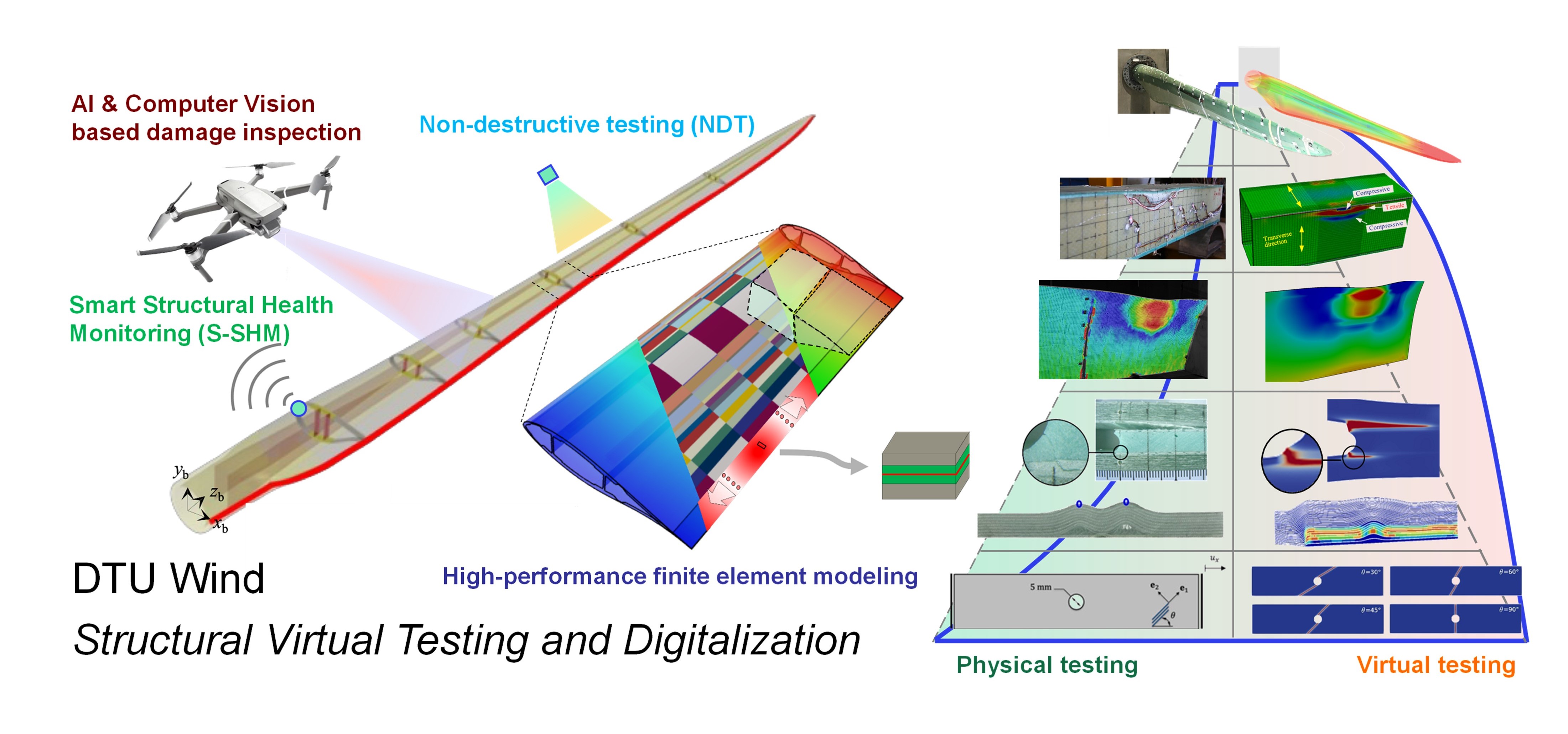
The main area of work is to develop knowledge and technologies for advanced structural inspection, encompassing quality control during manufacture, sensors and scanning during full-scale tests, and structural health monitoring during operation.
Key objectives for our section are:
to continue developing the AQUADA AI-assisted computer vision techniques and software for automated quantification of damage in large-scale composite structures
to maximize the potential of drones, robots and smart sensors to deliver high-quality data for trustworthy structural damage assessment
to interpret and integrate inspection results within actionable Asset Management tools such as 3D damage maps, defect criticalities, prognostics, and interactive digital twins
to develop the next generation of industrial software
We have strong experience working with wind turbine blades. However, our competencies can also be applied to other structures, such as large-scale aerospace composite structures, civil engineering structures, transition pieces of offshore wind turbines, etc.
We develop industrial software, including Wrinkle-Sim, AQUADA, and Blade Damage Map, as well as innovative applications of advanced sensor technologies such as thermography, acoustic emission, and ultrasound, for structural damage detection, monitoring, and evaluation
Disciplines
Competences
Research area & applications
Xiao Chen Head of Section xiac@dtu.dk